As many parents fear, the use of smartphones may be detrimental for their children’s social skills and mental health, as the users stop communicating and playing with their peers and retort to spending more time entertaining themselves online. Imagine a playground where laughter and chatter are replaced by silent screens and isolated gazes. With the rise of digital entertainment, children are spending less time playing and connecting with their peers and more time retreating into the virtual world. But is it just the children we should be worried about, or does this digital dependency also reflect our own struggles as parents? Loneliness is frequently described as a state of feeling socially isolated (Laursen and Hartl, 2013; Weiss, 1973).

Perlman and Peplau (1981, p. 31) defined loneliness as “the unpleasant experience that occurs when a person’s network of social relations is deficient in some important way, either quantitatively or qualitatively”. As Lawrence et al. (2022) stated: “Loneliness is a multi- dimensional, negative, and painful experience” (p. 1307). It is a complex and undesirable feeling even for us, grownups, so no wonder it can feel even more painful for the children, who are just figuring themselves out and thus find ways not to face this negative mixture of overwhelming emotions.
Before accusing the smartphones in stealing our kids’ socialisation, first it will be fair to distinguish between the uses of the smartphones, which can be divided into: 1) communicative and 2) non-communicative uses (Stevic & Matthes, 2021). Communicative use is represented in the opportunity for the kids to socialise and communicate via the social network platforms and messengers. Non-communicative use, on the contrary, indicates the passive use of the smartphones (playing games and consuming online content). As research demonstrated, the communicative use of smartphones can actually enhance subjective well-being (Chan, 2015), while engaging in online communication on Facebook positively correlates with improved relationship quality and well-being (Burke and Kraut, 2016). In contrast, passive or non-communicative use of Facebook and social networking sites (SNS) often led to negative emotions and a decline in well-being (Frison and Eggermont, 2015; Wang et al., 2018b).
For that reason, it is logical to presume that using smartphones as means for communicative use will not make any harm. However, it still does not mean that we can substitute all the communication with our phones entirely. The type of use of smartphones does matter. As the German study by Stevic and Matthes (2021) demonstrated, non-communicative use of phones (merely observing) may aggravate the feeling of loneliness. Due to the overwhelming feeling of loneliness and a lack of high-quality friendships (pertinent to the population age), children may feel isolated to interact with the peers, but because of the FOMO lonely children are more likely to engage in the non-communicative use of the internet, thereby, representing the “poor-get-poorer” effect, which therefore potentially leads to a prolonged vicious cycle of loneliness for children over extended periods. This finding was also in line with the previous research by Wang et al. (2018). As the same authors revealed, parental involvement and mediation does not hold any effect over the children’s phone use. This, however, may stem from the fact that not all parents understand when their children feel lonely, and for that reason it is crucial to build better communications and be engaged in the children’s social life, along with being able to educate about the caveats and possibilities of the smartphones’ use.
Researchers Shorter et al. (2022) also highlight the importance of distinguishing between the two types of loneliness: social and emotional, as each type has its own causes and coping behaviour. Emotional loneliness (Weiss, 1973) comes from the desire to build a deeper connection with other to feel secure, whereas social loneliness stems from the inability to feel belonging in a community because of the different values. For that reason, people often resort to combat their social and emotional loneliness using SNS, for example, when using Facebook (Teppers et al., 2013), however the study by Wang et al. (2018) demonstrated it can exacerbate the feeling of social loneliness, and it certainly does not make adolescents any happier in comparison to the real-life communication (Cauberghe et al., 2021).
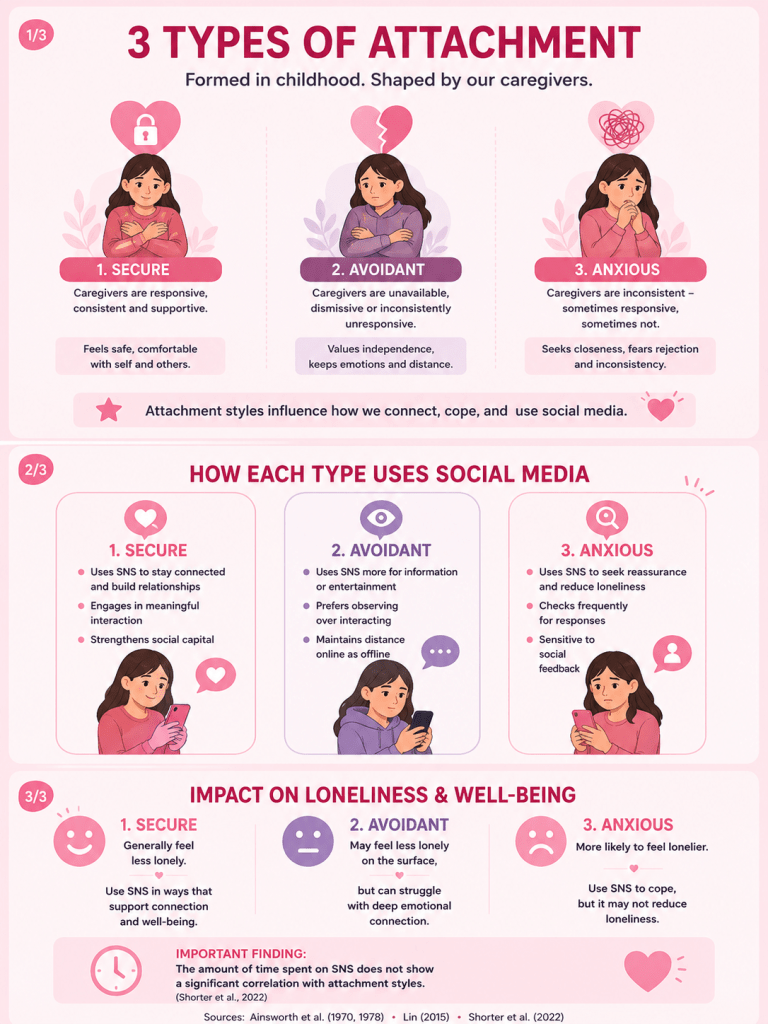
Attachment style also plays a significant role in how individuals use SNS. Ainsworth et al. (1970, 1978) identified three attachment types formed in childhood: secure (socially confident), avoidant (stemming from caregivers who failed to meet emotional needs), and anxious (resulting from inconsistent caregiving). Research suggests that securely attached individuals use SNS to strengthen social connections and enhance social capital (Lin, 2015; Shorter et al., 2022). In contrast, anxiously attached individuals tend to use SNS as a coping mechanism for loneliness (Shorter et al., 2022). However, surprisingly, the amount of time spent on SNS does not appear to correlate with attachment styles (Shorter et al., 2022).
Probably unsurprisingly, but girls are more likely to experience loneliness linked to social isolation compared to boys, according to the statistical analysis undertaken by Lawrence et al. (2022) on a population of 1919 secondary school adolescents aged 10–15 years over two years in Western Australia. Girls also tend to spend more time on the internet, in particular, for one hour longer (1.28 h) in comparison to the boys. Of course, when studies explore such a sensitive topic as loneliness and when they measure the loneliness according to various loneliness frameworks, it impossible to avoid all the research limitations to strengthen the rigour of the studies. Therefore, when analysing the research evidence, it is important to remember that many of the reported studies were self-reported, which could be influenced by social desirability bias (the behaviour when people want to be perceived in a better way), recall errors (people could forget all the details with time), or subjective interpretations. Also, some of the studies has a relatively homogenous population that did not include a diverse sampling (not intentionally but because of the school or region’s specificity). Apart from it, some studies reported being influenced by the external event when the data were collected (e.g., the COVID-19 pandemic, political events), which could also impact the dynamic in people’s behaviour and their screentime habits. Other than that, it is also crucial to stress that not all the parents may accurately know the exact amount of time their children spent having screentime, especially when the children grow older. By and large, it is getting clear why the children tend to retort to the SNS to avoid the feeling of loneliness. In this post I also shared the possible causes that can exacerbate the feeling of loneliness and caretakers may act upon them to help children live this experience in the most ecological way possible without developing a problematic use of the screentime.
Parents’ Takeaways: Helping Kids Navigate Loneliness and Screen Time
Understanding how loneliness and screen time interact can help parents support their children in healthy and practical ways. Here’s what to keep in mind:
1. Not All Screen Time Is Equal
✅ Encourage active use—video calls, messaging, and creative apps help kids connect.
❌ Limit passive scrolling—excessive gaming or social media lurking can deepen loneliness.
2. Real-Life Friendships Matter More
✅ Arrange playdates, sports, and outdoor activities to nurture social skills.
✅ Be a role model—reduce your own screen time and engage in meaningful family interactions.
3. Talk About Loneliness Without Judgement
✅ Help kids recognize and express their feelings instead of escaping into screens.
✅ Normalize loneliness—it’s a common experience, not something to fear.
4. Strong Parent-Child Bonds Reduce Loneliness
✅ Prioritize one-on-one quality time to foster emotional security.
✅ Stay involved in their friendships and online interactions without being intrusive.
5. Balance Tech With Real-World Engagement
✅ Set reasonable screen limits while offering engaging alternatives (sports, hobbies, books).
✅ Consider pet ownership—studies show pets can provide emotional comfort and reduce loneliness.
By fostering healthy digital habits, open communication, and strong real-world connections, parents can help children navigate loneliness and screen time in a balanced way.
References
Corsano, P., Musetti, A., Caricati, L., & Magnani, B. (2017). Keeping secrets from friends: Exploring the effects of friendship quality, loneliness and self-esteem on secrecy. Journal of Adolescence, 58, 24–32. https://doi.org/10.1016/j.adolescence.2017.04.010
Lasgaard, M., Armour, C., Bramsen, R. H., & Goossens, L. (2016). Major life events as predictors of loneliness in adolescence. Journal of Child and Family Studies, 25(2), 631–637. https://doi.org/10.1007/s10826-015-0243-2
Lawrence, D., Hunter, S. C., Cunneen, R., Houghton, S. J., Zadow, C., Rosenberg, M., Wood, L., & Shilton, T. (2022). Reciprocal relationships between trajectories of loneliness and screen media use during adolescence. Journal of Child and Family Studies, 31(5), 1306–1317. https://doi.org/10.1007/s10826-021-02066-3
Lin, J. H. (2015). The role of attachment style in Facebook use and social capital: Evidence from university students and a national sample. Cyberpsychology, Behavior, and Social Networking, 18(3), 173–180. https://doi.org/10.1089/cyber.2014.0341
Lin, S., Yuan, Z., Niu, G., Fan, C., & Hao, X. (2024). Family matters more than friends on problematic social media use among adolescents: Mediating roles of resilience and loneliness. International Journal of Mental Health and Addiction, 22, 2907–2925. https://doi.org/10.1007/s11469-023-01026-w
Panak, W. F., & Garber, J. (1992). Role of aggression, rejection, and attributions in the prediction of depression in children. Development and Psychopathology, 4(1), 145–165. https://doi.org/10.1017/S0954579400005617
Qualter, P., Brown, S. L., Munn, P., & Rotenberg, K. J. (2010). Childhood loneliness as a predictor of adolescent depressive symptoms: An 8-year longitudinal study. European Child & Adolescent Psychiatry, 19(6), 493–501. https://doi.org/10.1007/s00787-009-0059-y
Shorter, P., Turner, K., & Mueller-Coyne, J. (2022). Attachment style’s impact on loneliness and the motivations to use social media. Computers in Human Behavior Reports, 7, Article 100212. https://doi.org/10.1016/j.chbr.2022.100212
Stevic, A., & Matthes, J. (2021). A vicious circle between children’s non-communicative smartphone use and loneliness: Parents cannot do much about it. Telematics and Informatics, 64, Article 101677. https://doi.org/10.1016/j.tele.2021.101677
Teppers, E., Luyckx, K., Klimstra, T. A., & Goossens, L. (2014). Loneliness and Facebook motives in adolescence: A longitudinal inquiry into directionality of effect. Journal of Adolescence, 37(5), 691–699. https://doi.org/10.1016/j.adolescence.2013.11.003
Wang, K., Frison, E., Eggermont, S., & Vandenbosch, L. (2018). Active public Facebook use and adolescents’ feelings of loneliness: Evidence for a curvilinear relationship. Journal of Adolescence, 67, 35–44. https://doi.org/10.1016/j.adolescence.2018.05.008
Weiss, R. S. (1973). Loneliness: The experience of emotional and social isolation. The MIT Press.


Leave a comment